Jesus Christ was a man. Fully human. He was also fully divine. (Catechism of the Catholic Church paragraph 470). Unfortunately, as we approach the Triduum (Holy Thursday, Good Friday and Holy Saturday), we don't want to think too much about that human side of Jesus. Yes, he suffered and all, but he is God, so how hard could it be for him? Better yet, I don't want to think too much about that suffering part. It's bad enough he had to die, can't we just get on to the Alleluias and Easter candy?
At the risk of being labeled an Arian heretic, I like to think about Jesus' human nature and how hard the Passion was for him. I'm not talking about "The Passion of the Christ." I know Jesus' passion was very violent and physically painful (really torture), but what about the mental anguish? He clearly had second thoughts about dying the way he did: "My Father, if it is possible, let this cup pass from me." Matthew 26:39. Jesus was not running from the ordeal he would suffer, ("Take this cup away from me, but not what I will but what you will." Mark 14:36), but the Gospels are unified and very clear that he was distressed: "He was in such agony and he prayed so fervently that his sweat became like drops of blood falling on the ground." Luke 22:44. He wished it could be different; he was distressed; he was afraid for his disciples: "Get up and pray you may not undergo the test." Matthew 26:41. Clearly, this could have gone another way. Was he afraid? Did he think there could be a different path before he accepted the Father's plan? My heart breaks that he went through all that anguish for me.
That's the Jesus I think of during Holy Week - the man who was mentally tortured about how his death would go down and the fallout for his disciples. I also think about the same God who "so loved the world that he gave his only Son, so that everyone who believes in him may have eternal life." John 3:16.
Would you watch one hour with Him?
cc
Friday, April 18, 2014
This Is the Tough Part
Labels:
agony,
Gethsemane,
Good Friday,
Holy Thursday,
Triduum
Thursday, March 20, 2014
Life or Death
Today I attended a funeral. An old friend of mine lost her husband to colon cancer. He was 52. During the homily at the funeral mass the priest talked about how her husband found it so hard to beat the cancer but that several days before he died he had a sense of calm and peacefulness.
Why do people die "before their time"? If we, as people of faith, know they are going on to a place where every tear will be wiped away and there is no more suffering, why do we grieve them so much? Shouldn't we be happy for them? Why should someone fight an inevitable terminal illness and work so hard to stay alive even if life for them is so painful?
I thought a lot about these questions today. I definitely understand why we grieve. It is frightening and difficult to accept that someone we love so much, someone who is our life partner, someone with whom we are so intimately entwined is gone. Even people of great faith feel a deep sense of loss and pain. But what about the person who is dying?
As I pondered it, the answer came roaring at me like a flood. Life is a unique and special gift from God. It's a one shot thing. We only get one chance. Even people who don't know God have an instinct to preserve their lives. I think it's because everyone understands life has purpose and worth. The Catechism of the Catholic Church paragraph 1721 says it best: "God put us in the world to know, to love, and to serve him, and so to come to paradise." We inherently know we are here for a specific reason, even though we might not be so sure about what that reason is. I believe that's why we fight so ferociously to stay alive, even when the end is so close and we are suffering. The mind and the body want to live. We want that chance to know, to love and to serve.
I'm sure for many people death can be very scary, especially if you are not sure what comes next. I don't claim to have any special insight into that and the unknown scares me too. However, in the core of my being, the same core that will struggle to stay alive for as long as possible, I know one thing:
Why do people die "before their time"? If we, as people of faith, know they are going on to a place where every tear will be wiped away and there is no more suffering, why do we grieve them so much? Shouldn't we be happy for them? Why should someone fight an inevitable terminal illness and work so hard to stay alive even if life for them is so painful?
I thought a lot about these questions today. I definitely understand why we grieve. It is frightening and difficult to accept that someone we love so much, someone who is our life partner, someone with whom we are so intimately entwined is gone. Even people of great faith feel a deep sense of loss and pain. But what about the person who is dying?
God has made everything appropriate to its time, but has put the timeless into their hearts
so they cannot find out, from beginning to end, the work which God has done.
Ecclesiastes 3:11
As I pondered it, the answer came roaring at me like a flood. Life is a unique and special gift from God. It's a one shot thing. We only get one chance. Even people who don't know God have an instinct to preserve their lives. I think it's because everyone understands life has purpose and worth. The Catechism of the Catholic Church paragraph 1721 says it best: "God put us in the world to know, to love, and to serve him, and so to come to paradise." We inherently know we are here for a specific reason, even though we might not be so sure about what that reason is. I believe that's why we fight so ferociously to stay alive, even when the end is so close and we are suffering. The mind and the body want to live. We want that chance to know, to love and to serve.
I'm sure for many people death can be very scary, especially if you are not sure what comes next. I don't claim to have any special insight into that and the unknown scares me too. However, in the core of my being, the same core that will struggle to stay alive for as long as possible, I know one thing:
I know that my redeemer lives, and that in the end he will stand upon the earth.
And after my skin has been destroyed, yet in my flesh I will see God. Job 19:25-26.
I am so blest to know that. It makes me want to know, to love and to serve that same redeemer. However, when it is finally time to go on, those of us who remain need to say with gladness and joy:
May the angels lead you into paradise;
Upon your arrival, may the martyrs receive you
and lead you to the holy city of Jerusalem.
May the ranks of angels receive you,
and with Lazarus, once a poor man,
may you have eternal rest
Rest in peace, Mike.
CC
Thursday, March 13, 2014
Silence
It's been a week now since Lent began and it's been quite a week. I gave up three things for Lent:
(1) refined sugar;
(2) use of my cell phone for anything other than telephone calls or text messages (no apps, FB, Twitter, etc.); and
(3) use of my car sound system (radio).
I really thought sacrificing refined sugar was going to be hard and I am reminded of Christ's suffering every night when I really want something sweet. However, I was not prepared for the real mortification - going without my car radio.
I drive 60 miles a day during my work commute. I'm not used to sitting in silence. It feels weird. When I get into the car, I immediately feel like something is missing. It's just automatic - I want to hear noise. The silence is deafening and it's hard to be a captive to the silence.
I am making good use of my time. I'm praying. Lots of rosaries and Divine Mercy chaplets. They have been great, but I am still looking for more. The Catechism of the Catholic Church addresses this issue:
(1) refined sugar;
(2) use of my cell phone for anything other than telephone calls or text messages (no apps, FB, Twitter, etc.); and
(3) use of my car sound system (radio).
I really thought sacrificing refined sugar was going to be hard and I am reminded of Christ's suffering every night when I really want something sweet. However, I was not prepared for the real mortification - going without my car radio.
I drive 60 miles a day during my work commute. I'm not used to sitting in silence. It feels weird. When I get into the car, I immediately feel like something is missing. It's just automatic - I want to hear noise. The silence is deafening and it's hard to be a captive to the silence.
I am making good use of my time. I'm praying. Lots of rosaries and Divine Mercy chaplets. They have been great, but I am still looking for more. The Catechism of the Catholic Church addresses this issue:
"Contemplative prayer is silence, the 'symbol of the world to come' or 'silent love.' Words in this kind of prayer are not speeches; they are like kindling that feeds the fire of love. In this silence, unbearable to the 'outer' man, the Father speaks to us his incarnate Word, who suffered, died, and rose; in this silence the Spirit of adoption enables us to share in the prayer of Jesus." CCC 2717
Sometimes it feels like He's not speaking to me, but I know that can't be true. I think I'm so used to noise, I don't know how to listen. I'm working on it. It is a sacrifice for me to go without audio stimulation, but I'm hoping through this sacrifice to get a better sense of what it feels like to be quiet and wait for God to speak.
"My soul waits in silence for God only;
From Him is my salvation" Psalm 62:1
CC
Labels:
contemplative prayer,
Lent,
sacrifice,
silence
Tuesday, March 4, 2014
Giving It Up
Tomorrow is Ash Wednesday. Watch this video to get Ash Wednesday and Lent in just 2 minutes:
I can get a little peevish about Ash Wednesday - from an attendance standpoint it's the next best thing to Christmas or Easter. Uggghhh! But enough with my peevishness. I need to give it up for Lent.
Ahh, the Catholic practice of "giving up" something for Lent. Candy, soda, TV, internet - yep, done those. What's the point? Wouldn't it be better to do something positive like reading the Bible every day during Lent or spending more time in prayer? Actually, it's not an either/or question, but a both/and answer. Lent is a time of prayer, fasting, abstinence and almsgiving. We should pray AND fast AND abstain AND give alms. There is a real reason for "giving up" something. Jesus did it for 40 days in the desert. Matthew 4:2. Fasting is very Biblical, as is abstinence, especially in the flesh. Romans 8:13. That's why the Church asks Catholics to abstain from meat on Ash Wednesday and Fridays during Lent and also to fast on Ash Wednesday and Good Friday. We're not looking for a diet here (although that might be nice), but the whole point is to "die to self".
By choosing to give up something you really like (candy, TV, internet), you can suffer a small mortification and join in Christ's sufferings (even if it is just a little). Giving up something I love can hurt. In my case I'm giving up refined sugar for Lent. Trust me, this is going to hurt. It's not a requirement to give something up (except for abstaining from meat on Fridays), but if I'm trying to feel a little pain to be closer to Jesus in the desert it certainly helps.
The almsgiving can be tough too. When we were kids we always had little cardboard boxes in the shape of "rice bowls." We put our coins in there for the poor children in Africa. Although that does sound hokey, our teachers were trying to teach us the practice of almsgiving. I think even more than prayer, fasting and abstinence, a special emphasis on almsgiving can be difficult. I'm going to have to think about that one.
I'm praying about keeping these spiritual exercises during Lent - it's hard when the Easter candy shows up in the stores - which is like, now. The great thing about doing these little mortifications is that Easter becomes a real celebration of the "joy in the morning" after the desert of Lent.
And that, my friends, makes it sweeter than Peeps (sorry, I couldn't help that one!).
Have a prayerful and sacrificial Lent.
CC
Labels:
abstinence,
almsgiving,
Easter,
fasting,
Lent,
prayer,
sacrifice
Saturday, February 22, 2014
James 1:19
Know this, my dear brothers and sisters:
everyone should be quick to hear, slow to speak, slow to anger
for anger does not accomplish
the righteousness of God.
These words from the letter of James struck me this week - they were part of the daily readings on Wednesday. They cut right through me. I can't tell you how many times I have been slow to hear, quick to speak and quick to become angry. These words have echoed through my mind over and over.
Quick to hear
I ask myself - how can I be "quick to hear"? I want to speak before the other person is done talking. I want to make my point before I forget it. I want to "solve" their problem or offer unsolicited advice. Part of being quick to hear is understanding that not everyone who tells you about their life wants advice.
Slow to speak
Ouch. That's a real problem. I always have something to say and it frequently results in putting my foot in my mouth. It's a horrible feeling to look back on the day and regret so many things you said that didn't need to be said. Words that hurt, that tear down, that spread negative attitudes - it doesn't matter if you intended to bring hurt and negativity. You did.
Slow to anger
If you have ever spent time with preschool age children, you know that controlling anger is a difficult skill to learn. Why do I need to control my temper? It's the way I feel and I can't help how I feel! By the time kids are in second grade they understand that while they can't control their emotions, they need to have enough self-control so their anger doesn't lead them. Sometimes I think I need to go back to kindergarten.
I keep reading these words and I do see a pattern. It's the way of Christ. It begins with being quick to hear. Listening. Hearing. Chewing on the words, the body language, the messages of others, the meaning. If I'm keeping the hearing slow, that keeps me from speaking too quickly. Do I really need to say something? Will my words have a positive impact? Does my yes mean yes and my no mean no? If I'm slow to speak it makes it less likely that my anger will escape. I won't have to go back to preschool. Outbursts of anger aren't just embarrassing, they are destructive.
Anger does not accomplish the righteousness of God.
I believe God wants to use us to be the light of Christ. I can't see the person of Jesus, but I can see Him in my brothers and sisters who are quick to hear, slow to speak and slow to anger. They show me there is an alternative to the noise, the arguing, the constant assault of sound. It's peace. Peace is my word this year and I may just find it if I listen more, speak less and keep my anger in check.
Know this, my dear brothers and sisters:
everyone should be quick to hear, slow to speak, slow to anger
for anger does not accomplish
the righteousness of God.
cindy
Labels:
anger,
James 1:19,
listen,
peace,
speak
Thursday, February 13, 2014
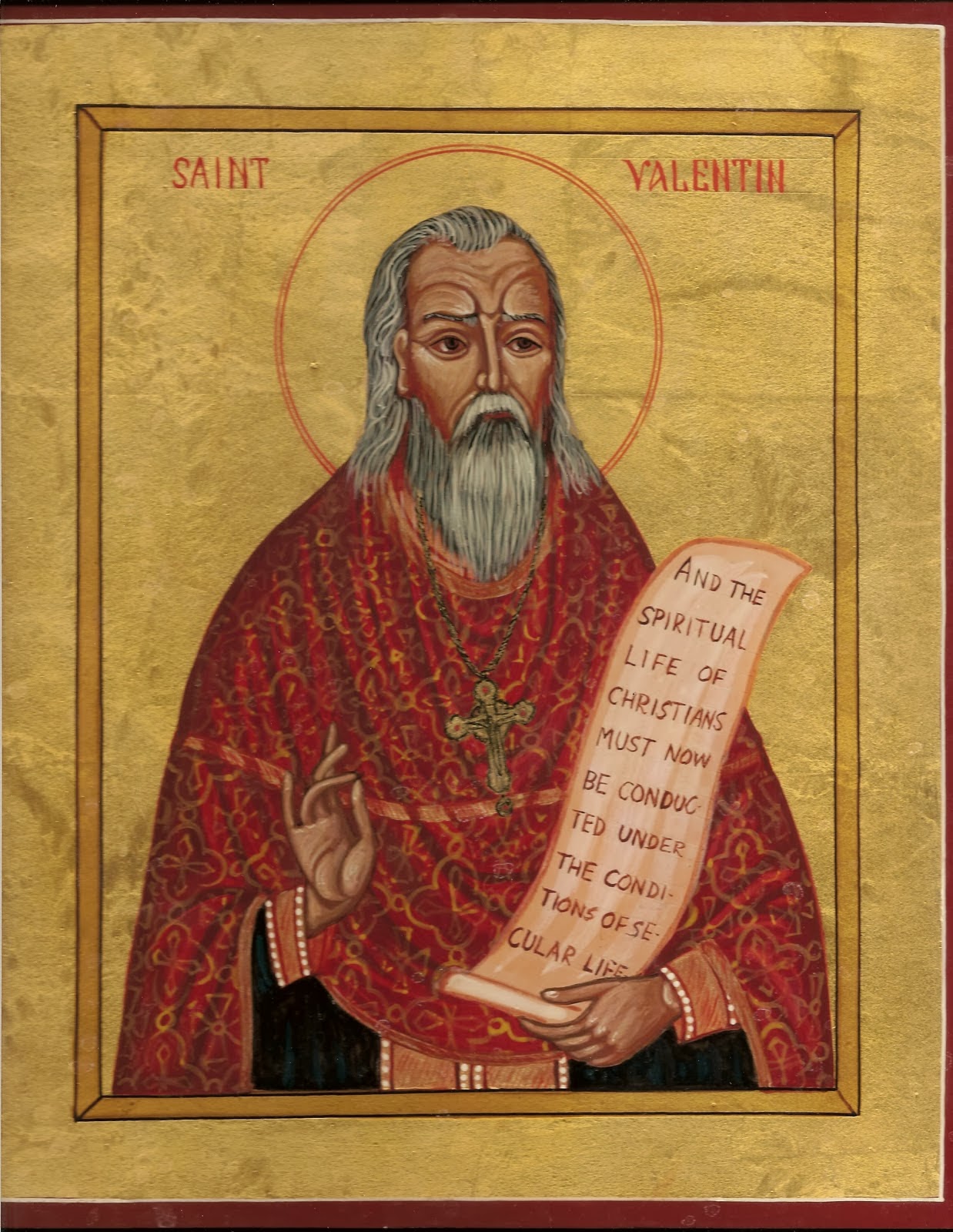
What About the Saint in Valentine's Day?
The day traditionally associated with love and romance is nearly upon us. Friday is the feast of St. Valentine, but much of the world might not realize that. So just who was St. Valentine and how is he connected with love?
There are many St. Valentines in the Roman calendar (Valentinus was a popular name), but the one celebrated on February 14 may be one or two people. There was a martyred third century bishop named Valentine, but also a Roman priest by the same name who was martyred under the rule of the Emperor Claudius. There is also a theory that these descriptions are of the same person. One thing we do know - this man was martyred for his faith. As a pope in the fifth century noted, Valentine's acts are known to God alone, and that was probably good enough for Valentine.
So why is this saint connected with hearts and flowers? It has nothing to do with the man, at least not St. Valentine. The connection lies with Geoffrey Chaucer and his poem Parlement of Foules (1382). In modern English: "For this was on St. Valentine's day when every bird comes there to choose his mate." Birds, mates, flowers, candy, cards - you get it.
I still think this saint is associated with love. St. Valentine, whoever he was, loved God enough to die for Him.
CC
Labels:
martyr,
St. Valentine,
Valentine's Day
Monday, February 3, 2014
There's Something About Mary
My mother's name was Mary. She was a really good mom and I loved her. She was strong in her faith and I would like to think I share that with her. She didn't talk about it much, but I know she believed in the power of prayer. Like most people, when I had problems, I talked to my mom. I asked her help. I knew she would do anything she could for me even if she could not directly solve the problem.
One of the most common misunderstandings non-Catholics have about Catholicism is our devotion to Jesus' mom, Mary. We call her the Blessed Virgin, Our Lady, Mother of God, Queen of Heaven and many, many more titles, but bottom line, she's Jesus' mom. We don't see that as just another woman in the salvation story. She's His mom.
When we were planning our wedding, I told the parish administrator who was with our ceremony that I wanted to include "flowers to Mary," a moment where I could take flowers to a statue of Mary and say a prayer. I was told that they didn't do that unless there was a specific devotion to Mary. I told them I had a special devotion. I'm not sure if I really considered it that at the time, but it was important to me to include it in our wedding. I remember asking Mary to pray for our marriage.
I think a lot of people don't understand what it means to "pray" to Mary. I don't think Mary has the ability to do things only God can do. When I "prayed" to her during my wedding, I wasn't asking for her to do anything really supernatural. I was just asking her to join me in praying for our marriage. I know my mother was praying, why wouldn't I want Jesus' mother interceding for His blessing on our marriage?
When we were having difficulties having a baby, there was a moment in the Cathedral Basilica of St. Francis of Assisi in Santa Fe, New Mexico where I said a prayer before an image of Mary. I didn't realize it at the time, but it was La Conquistadora, Our Lady of the Rosary, the oldest image of Mary in the Americas. I laid it all there - my fears, the pressure, all of it. As I stood up, I felt a real sense of release. I knew there was another person helping me. It's the same kind of thing I would ask my mom.
I recognize that a devotion to Mary and her unique role in the Church can't be fully described in this short post. However, I do think it's a starting point to understanding of how she helps me, mothers me, intercedes for me.
After all, if you want help trying to persuade a guy to do something, who better to ask than his mother, right?
CC
One of the most common misunderstandings non-Catholics have about Catholicism is our devotion to Jesus' mom, Mary. We call her the Blessed Virgin, Our Lady, Mother of God, Queen of Heaven and many, many more titles, but bottom line, she's Jesus' mom. We don't see that as just another woman in the salvation story. She's His mom.
When we were planning our wedding, I told the parish administrator who was with our ceremony that I wanted to include "flowers to Mary," a moment where I could take flowers to a statue of Mary and say a prayer. I was told that they didn't do that unless there was a specific devotion to Mary. I told them I had a special devotion. I'm not sure if I really considered it that at the time, but it was important to me to include it in our wedding. I remember asking Mary to pray for our marriage.
I think a lot of people don't understand what it means to "pray" to Mary. I don't think Mary has the ability to do things only God can do. When I "prayed" to her during my wedding, I wasn't asking for her to do anything really supernatural. I was just asking her to join me in praying for our marriage. I know my mother was praying, why wouldn't I want Jesus' mother interceding for His blessing on our marriage?
When we were having difficulties having a baby, there was a moment in the Cathedral Basilica of St. Francis of Assisi in Santa Fe, New Mexico where I said a prayer before an image of Mary. I didn't realize it at the time, but it was La Conquistadora, Our Lady of the Rosary, the oldest image of Mary in the Americas. I laid it all there - my fears, the pressure, all of it. As I stood up, I felt a real sense of release. I knew there was another person helping me. It's the same kind of thing I would ask my mom.
I recognize that a devotion to Mary and her unique role in the Church can't be fully described in this short post. However, I do think it's a starting point to understanding of how she helps me, mothers me, intercedes for me.
After all, if you want help trying to persuade a guy to do something, who better to ask than his mother, right?
CC
Labels:
Blessed Virgin Mary,
Mary,
Mother of God
Subscribe to:
Posts (Atom)